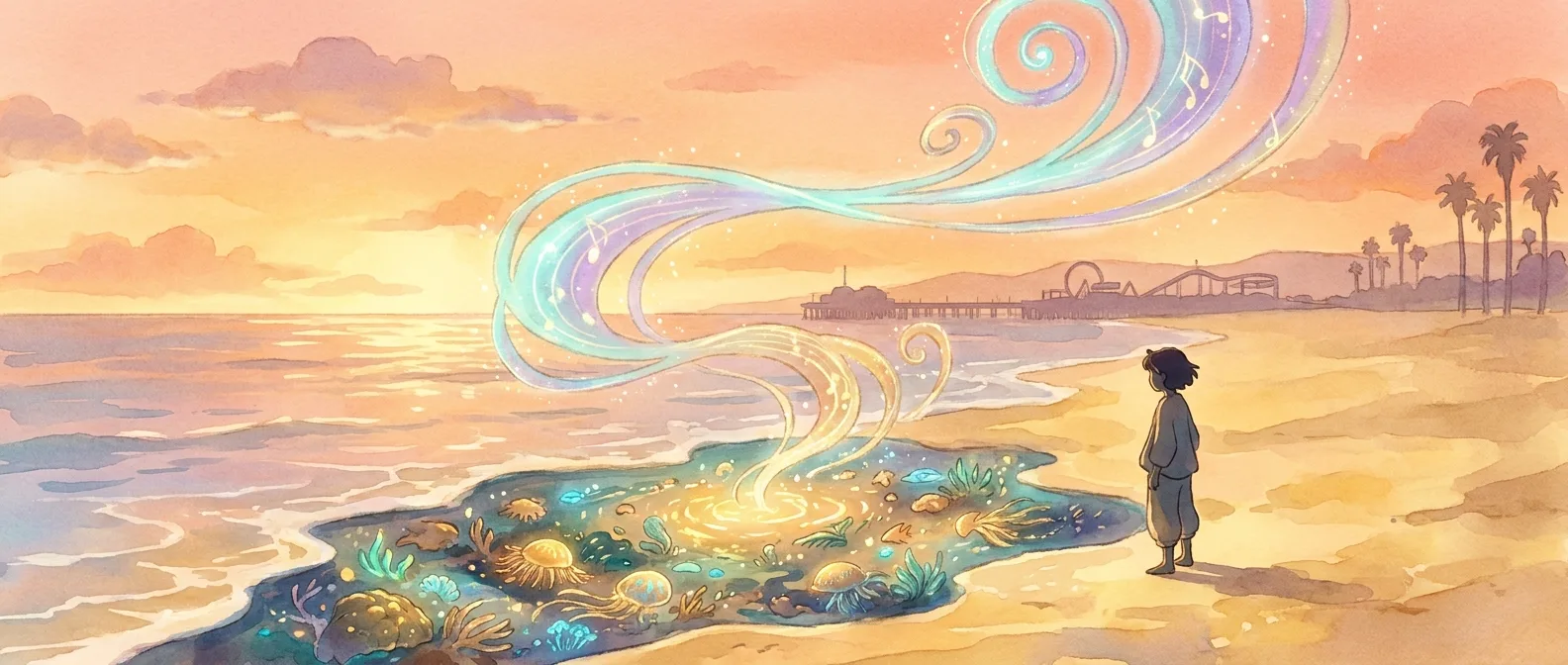
Stand at the edge of a tide pool and you hear waves. Underneath the sound you can hear, there is another signal you cannot: traces of thousands of species — bacteria, plankton, fungi, things without common names — that live in, or lately passed through, that small pocket of water. A coral reef is not silent information-wise — it is shouting, in a medium that isn’t sound. We just have no ear for it.
What if we built one?
That question is the seed of the World Genome Symphony — a project we are building to turn environmental DNA into music and light. Not a soundtrack laid over a chart. The actual genetic data of an ecosystem, thousands of species in a single sample, used to generate a score in real time. Reading all of them at once is itself recent magic: metagenomic sequencing untangles the mixed-together DNA in one scoop of water and sorts it back into thousands of separate organisms — something that only became possible when computers grew powerful enough to do the untangling. Biodiversity you can listen to. Ecosystem health you can feel in the room.
An instrument, not a visualization
Here is the part I find genuinely thrilling. The design is not “play a recording while a graph animates.” It is an instrument. A musician stands on stage and plays alongside the data — a duet between a human performer and the living chemistry of a reef or a patch of soil, the organisms supplying a part no composer wrote.
To make that work, the design splits time in two. Sequencing the sample is the slow movement — real chemistry that takes minutes to hours, done before or during the event as data streams off the machine. The live loop is everything downstream: classify what is in the stream, measure its diversity, turn that into a score, synthesize the audio, and render the visuals — fast enough that a performer can answer it as it happens. That downstream chain is what the design targets at under 100 milliseconds end to end, running across federated machines on Lattice Protocol so the heavy computation can sit wherever the GPUs are while the sound stays in sync at the venue.
None of this is built yet. The Symphony is in its design phase — the architecture is drawn, the audio synthesis is not written, the debut is a plan and not a memory. I would rather tell you that plainly than oversell a prototype. The aim is a first performance at Muscle Beach, in Venice Beach, in the summer of 2027.
Three ways in
The design has three modes, because biodiversity should not only be a show you watch.
In Show Mode, musicians perform live duets with ocean microbiome data in front of an audience. In Gallery Mode, you walk up to an installation and a rainforest, a kelp forest, a prairie, or a city park plays its own genetic score while you stand inside it. In Educational Mode, students run the whole loop themselves: extract DNA from a sample, sequence it on a pocket-sized device, classify the organisms, design how the data becomes sound, and listen to a piece of music no one has ever heard — because no one has ever sampled exactly that handful of dirt before.
That last mode is the one I care about most. A student does not receive the Symphony. She makes one.
Why bother making biology audible
Science is already beautiful. The complexity in a gram of soil needs no decoration. But beauty you cannot perceive does not move anyone, and most of biology’s beauty is locked behind microscopes and databases that only specialists ever open.
Sound is a way in that asks for no degree. You do not have to understand metagenomics to feel a reef’s diversity thin out as it dies, or thicken as it recovers. The ocean is a body, and the water is its blood; the Symphony is an attempt to let a room full of people feel that pulse directly, without translation.
We are still building the instrument. But the idea underneath it is simple, and I think it is right: every sequence in that sample traces back to something real — an organism living there now, or one that passed through and left its signature. Environmental DNA is the water’s memory as much as its census, and behind every data point is life. Make the data sing and the melody is ours — sonification is a translation, and someone has to choose the key. But what it translates is not invented: the diversity, the rhythms, the rise and fall of living communities are all real. The song is the metaphor. What it’s about has been under your feet, and under the waves, the whole time.